
Acupuncture in The Adventures of The Pharmacist
On December 13, 2019, a new episode on acupuncture was released in the series The Adventures of The Pharmacist. First, I would like to thank Mr. Bernard for offering this opportunity to bring the discussion about acupuncture to the forefront. Mr. Bernard had already addressed the subject of acupuncture in the context of his humorous comic strips, but did so clumsily, as he would later admit himself on his own platform. He faced censorship following this publication, which drew criticism for its content regarding acupuncture.
The attack by pharmacists against Traditional Chinese Medicine (TCM) is well documented. Historian Tamara Venit Shelton's book describes this phenomenon. (1) In America, this competitive phenomenon is said to have begun around 1870. Indeed, the American population already appreciated Chinese physicians and their results at that time.
More recently, Mr. Bernard raised in an interview with the journal University Affairs about misinformation: "There are plenty of people speaking on our behalf, about our subjects, it makes no sense," denounces the pharmacist. (2) Despite this eloquent discourse, Mr. Bernard pronounces on this subject for which he holds no expertise: acupuncture.
Missed Appeals to Authority
In his approach, Mr. Bernard mentions that he consulted the Ordre des acupuncteurs du Québec (Quebec College of Acupuncturists). However, it would not have been possible for the parties to reach an agreement.
Next, Mr. Bernard falls back on an interview with the secretary of the Collège des médecins du Québec (Quebec College of Physicians). I fail to see how the College of Physicians could have an official position regarding acupuncture. Dr. Yves Robert mentions this moreover during the interview. The College of Physicians was responsible for overseeing acupuncture from 1977 to 1995 in Quebec. However, for more than 20 years now, it is the Quebec College of Acupuncturists that is responsible.
Level of Evidence
Mr. Bernard claims that science would not be clear regarding the effectiveness of acupuncture and wonders whether acupuncturists have exaggerated claims about the scope of their treatments.
Yet science is now rather clear regarding the effectiveness, cost-effectiveness, and safety of acupuncture for dozens of common applications.
Although undisputed and largely ignored in the criticism of Dr. Novella, interviewed during the episode, the mechanisms of action of acupuncture are the subject of flourishing research. The mechanisms regarding the treatment of pain, inflammation, allergic rhinitis, among others, are well documented. The fact that not all mechanisms of action for each of the pathologies effectively treated by acupuncture have yet been discovered does not diminish the clinical effectiveness of acupuncture. Moreover, there are several models of systemic physiological explanations for the effects of acupuncture treatment, for which I suggest further reading below.
Indeed, several medical treatments are used despite an unsatisfactory explanation of their specific mechanisms of action. As emphasized by Dr. Yves Robert of the CMQ, it is the results, or outcomes, that matter most in terms of protecting public health. Let the public therefore speak on this subject.
Effectiveness of Acupuncture: What Quebecers Say⚜️
Here are some figures from a survey of 1,000 Quebec patients, conducted by an independent firm, commissioned by the Association of Acupuncturists of Quebec in 2017:
• 92% of surveyed patients reported observing positive results following their treatments
• 75% of respondents underwent fewer than 15 acupuncture treatments, with nearly half of them having had fewer than five treatments …
• 95% of patients indicated that they would consult an acupuncturist again if the pain or symptoms for which they were treated returned." –AAQ
Effectiveness of Acupuncture: What Science Says
Note that the clinical reality of acupuncture indeed exceeds the scope of the lists presented below. One should not compare this practice to off-label use of medications. Without question, empirical clinical protocols have existed for thousands of years in acupuncture literature for numerous applications that have not yet been re-evaluated by the scientific method.
Nonetheless, the current scientific method recognizes a level of evidence of moderate to high grades for the effectiveness of acupuncture in dozens of health disorders. Here is a list of 47 of these applications.
The following data on acupuncture effectiveness are drawn from the literature review by McDonald and Janz, published in 2017, (3) which has the merit of clearly classifying the level of evidence regarding published scientific research to date on acupuncture.
High Level of Evidence:
Knee osteoarthritis
Chronic lower back pain
Allergic rhinitis (perennial and seasonal)
Chronic headache
Tension headache
Migraine prophylaxis (preventive treatments for recurrent migraines)
Postoperative pain
Perioperative nausea/vomiting
Nausea/vomiting due to chemotherapy
Moderate Level of Evidence:
Anxiety
Insomnia
Depression
Constipation
Irritable bowel syndrome
Post-traumatic stress disorder
Smoking cessation (up to 3 months)
Asthma in adults
Obesity
Sciatica
Lateral epicondylitis
Neck pain
Heel pain
Acute lower back pain
Temporomandibular joint pain
Acute subacromial impingement of the shoulder (with exercise)
Low back and pelvic pain during pregnancy
Labor pain
Chronic pelvic pain
Prostatitis pain
Dry eye
Hypertension (with medication)
Hot flashes during menopause
Perimenopause and postmenopause insomnia
Aromatase inhibitor-induced arthralgia
Restless leg syndrome
Modulation of sensory perception threshold
Acute phase stroke
Stroke rehabilitation
Post-stroke insomnia
Post-stroke shoulder pain
Post-stroke spasticity
Schizophrenia (with medication)
Anesthesia during craniotomy
Ambulatory anesthesia
Cancer-induced pain
Cancer-induced fatigue
Recovery following colorectal cancer resection
Mechanisms of Acupuncture Treatment⚔️
Here is a video synthesis (in English) of one of the biochemical mechanisms of action of acupuncture treatment, prepared by the organization Evidence Based Acupuncture:
Lund & Lundeberg present in 2016 an interesting synthesis of the mechanisms of electroacupuncture.
I also recommend the skillfully summarized explanation by a fellow acupuncturist colleague, also researcher and professor in the same field, Dr. John McDonald.
Plurality of Physiological Models
Regarding another point raised by Mr. Bernard, there are several physiological models in Traditional Chinese Medicine. This should be a source of concern according to his perspective. The fact that several treatment systems or schools of thought—auricular acupuncture, points off meridians, etc.—are used in clinical practice does not diminish acupuncture's effectiveness either. This plurality of modalities is actually one of the clinical strengths of this traditional medicine. This is indeed the practice that takes more time to master and is partly why acupuncturists are subject to continuing education requirements in Quebec under the guidelines of the Quebec College of Acupuncturists.
Specificity of Acupuncture Points
The acupuncture points described by Traditional Chinese Medicine do indeed exist! From a scientific perspective, there is also emerging data regarding the anatomical characteristics of acupuncture points and the mechanisms specific to these anatomical sites.
Here are some common features of these biostimulation sites called "acupuncture points":
- Acupuncture points are reputed to be sites of lower electrical resistance, which can be easily measured using a device useful for electricians, the ohmmeter. Electroacupuncture-specific devices come with a probe allowing instrumental location of these sites.
- Mast cells and nerve cells appear to share perivascular anatomical locations (around blood vessels). These 2 types of cells, mast cells and nerve cells, are found in abundance at the anatomical location of acupuncture points. We now understand that acupuncture points have in common that they represent plexuses where these specific cells meet in abundance. Peripheral stimulation by acupuncture of these specific points induces histamine release by mast cells. Histamine excites receptors on primary sensory neurons and leads to an interaction with receptors in the nervous system, thus potentially affecting all bodily functions. Immune system cells located at acupuncture points therefore play a key role in the response to acupuncture.(4)
- One of the reasons why it is better to be an acupuncturist to use acupuncture needles: they function fully when one punctures acupuncture points, indeed! Researchers measured a biomarker, nitric oxide (NO), to conclude that the truly positive effect of acupuncture on blood circulation manifests completely when puncturing acupuncture points, properly speaking. (5)
- When comparing functional magnetic resonance imaging results of patients who received stimulation of false acupuncture points to those who actually received acupuncture treatment on true acupuncture points, the changes persist after treatment only in those who benefited from the real intervention on genuine acupuncture points. (6) (7)
Comparison of Acupuncture to Other Interventions
Dr. Novella compares acupuncture to light massage. This is an opinion.
Let us see what serious evidence-based data have to say in comparative terms for 2 very common health disorders: sciatica and knee osteoarthritis.
Order of Effect Size by Interventions for Sciatica
Overall Effect
Biomedicines (TNF modulators)
Acupuncture
Manipulation
Perioperative interventions
Epidural injections
Spinal cord stimulation
Disk surgery
Non-opioids
Education and advice
Chemonucleolysis
Passive physical therapy
Neuropathic modulators
Rest
Traction
Percutaneous discectomy
Opioids
Therapeutic exercise
Usual care
Intradiscal injection
Radiofrequency treatment
Effect on Pain Intensity
Biomedicines (TNF modulators)
Acupuncture
Perioperative interventions
Neuropathic modulators
Epidural injections
Disk surgery
Manipulation
Chemonucleolysis
Therapeutic exercise
Non-opioids
Usual care
Traction
Passive physical therapy
Opioids
Percutaneous discectomy
Radiofrequency treatment
Education and advice
Rest
(8)01497-6)
Ranking of Physical Treatments for Knee Osteoarthritis Pain
Acupuncture
Balneotherapy
Sham acupuncture
Muscle exercises
Tai Chi (Tai Ji Quan)
Weight loss
Aerobic exercise
>
MacPherson et al. summarize well: acupuncture is more effective than usual care and placebo acupuncture (sham acupuncture) for chronic pain, based on the most robust data from high-quality clinical trials on acupuncture in the treatment of chronic pain. (10)
Effect Size of Complex Interventions
The double-blind randomized controlled trial: an immutable gold standard?
The effect size of acupuncture is constantly underestimated in randomized controlled trials with a placebo group. This distortion inherent to randomized controlled trials is not isolated to acupuncture. Indeed, surgical interventions and psychiatry are also common complex clinical interventions in real-world practice that also cannot be properly evaluated using the gold standard of the double-blind randomized controlled trial.
Secondarily, the practice of polypharmacy—that is, the use of more than one molecule for pharmacological treatment, a fairly common phenomenon in practice—is not anchored in evidence-based data from the standard of the double-blind randomized controlled trial on an individual molecule. Yet this is notably the research model that leads to approvals for pharmaceutical product commercialization. (11)
We will focus here on studies on acupuncture. One of the main reasons for the usual underestimation of effect size is that sham needles, or false needles—placebo needles—do not constitute a true control group in the strict sense. It is simple: they have been demonstrated to be active. A placebo is supposed to be inert in order to compare with the treatment under study, supposed to be active. In a meta-analysis of 37 clinical studies involving a total of 5,754 patients, Linde K et al. demonstrated that the effects specific to the intervention called sham acupuncture are moderately large. (12)
Furthermore, historically, among the 9 needles described in the Ling Shu, 2 of them were not meant to pierce the skin, but rather to perform a form of acupressure. Such needles—having been wrongly assumed to be inactive by sham needle methodology—are therefore used in the development and implementation of clinical protocols that are actually quite active, and have been since the beginning of the practice of acupuncture as it is used today.
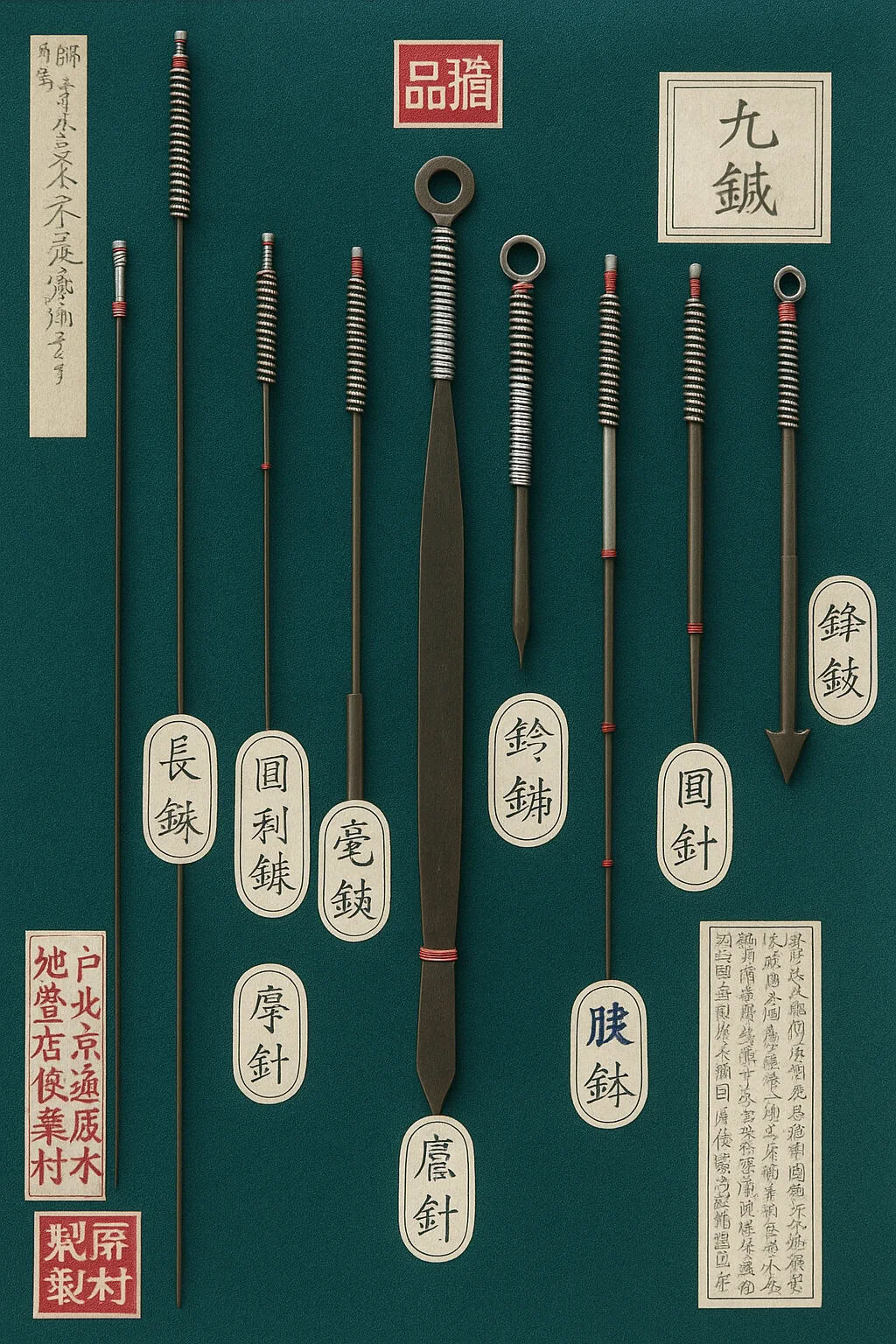
Ancient acupuncture needles, as described in the Ling Shu
Filiform needles, thin as a hair, are the most used and best known for contemporary clinical acupuncture practice. However, the other needles are not entirely excluded from today's practice, although they would rather be reserved for specific practices. Needle techniques are also described in the Ling Shu, which number 26 distinct manipulations. Apart from the filiform needle and the 2 more blunt needles mentioned above, only 2 needles were reserved for piercing capillaries or blood vessels for bloodletting—the arrowhead needle and the prismatic needle, today replaced by the lancet and the triangular needle. Mr. Bernard therefore also fails in his description of original acupuncture needles.
Rewriting History... And Saying Just About Anything
Indeed, Mr. Bernard, who does not deny being a total novice to acupuncture, nonetheless does not hesitate to rewrite the history of acupuncture! The most humorous part, but which could seem racist: according to his animated character, the fact that a collective of authors contributed to the writing of a work would invalidate it. Rather surprising from someone who claims to be passionate about scientific studies and publications. Very few are published by a single person.
The allegations held by Mr. Bernard about the history of acupuncture are even more amusing than his comic strips. The false history of acupuncture is moreover a popular narrative in the pseudo-skeptic world. Acupuncture never disappeared in China. It was removed from the Imperial Medical Academy as a subject of study under the Qing Dynasty, and was also 'banned' under Kuomingtang governance, one of the first political parties of the Chinese Republic, but what happened is that it simply moved to a more 'underground' status at that time. Under Mao, colleges of Traditional Chinese Medicine and research institutes were created. But Mao did not 'bring back' acupuncture. Acupuncture was always present, even through its more marginal period.
Quality of Data Raised⚖️
Research in China sometimes comes under vehement criticism. We must not lose sight of the fact that this kind of criticism is sometimes also a form of racism. And yes, clinical research published in China is of variable quality, like any other research published elsewhere. The problem of the quality of published data is a worldwide phenomenon to which the international scientific community is only beginning to pay attention: think namely of the negative publications of sponsored pharmaceutical research, which are not published. (13)
Mr. Bernard starts from a false premise when he asserts by generalizing that systematic reviews on acupuncture that reach positive conclusions about acupuncture would be contaminated by poor quality studies. In general, what must be understood is that poor quality studies are excluded from systematic reviews, regardless of country of origin, based on a risk of bias analysis. Dr. Novella likewise ignores in his interview these tools used in the critical evaluation of the quality of research included in systematic reviews on acupuncture.
Clinical Recommendations Favoring Acupuncture
Let us take as examples a few international reports on the practice of acupuncture. Publications namely made in the United States by the Agency for Healthcare Research and Quality, (14) the ICER, (Institute for Clinical And Economic Review) (15) and the US Veteran Affairs department. (16) Also note that of New Zealand, prepared by the government agency Accident Compensation Corporation. (17) These analyses all found, at minimum, moderate quality evidence data, defining acupuncture as safe and effective.
There are currently no fewer than 13,675 clinical studies on acupuncture registered in the Cochrane Register of Clinical Trials. The latest data from Stephen Birch et al. demonstrate that there are 4,522 positive recommendations for the use of acupuncture in clinical practice, according to 2,217 different publications. (18)
The Joint Commission in the United States has issued the following mandate to accredited hospitals: they must all officially recommend non-pharmacological options for pain management as of January 1, 2018. Among these, acupuncture is the non-pharmacological approach supported by the most solid evidence base. (19)
Safety of Acupuncture Practice
There would be no serious safety risk with acupuncture in a regulated practice context.
Unfortunately, modern medicine cannot always say the same. In the United States, the 3rd leading cause of death is…drumroll…medical errors from modern medicine! (20) (21)
To your health!
Acknowledgments
I wish to thank my Australian colleague Dr. John McDonald for his participation in the formulation of this text, but above all for his research work and awareness-raising on evidence-based acupuncture. Dr. John McDonald began his study of acupuncture in 1971. He has been teaching acupuncture since 1977. He publishes as both researcher and science communicator. He is also vice-president of the research division of the Acupuncture Now Foundation. He completed a thesis titled The Effects of Acupuncture on Mucosal Immunity in the Upper Respiratory Tract. He published in 2017 The Acupuncture Evidence Project: A Comparative Literature Review, for which he received an award. He has also published several peer-reviewed articles, academic reports, books, participated in the writing of white papers, in addition to publications for the general public.
References
(1) Attacks on Purported Quacks. How legislation targeted Chinese doctors in America. By Tamara Venit Shelton, Excerpt From Herbs and Roots: A History of Chinese Doctors in the American Medical Marketplace, Tamara Venit Shelton, Yale University Press, 2019 "Regular physicians recognized Chinese doctors as competitors as early as 1870...A newspaper article on Chinese medicine noted, "In San Francisco, the regular physicians complain bitterly of the inroads made upon their incomes by the Chinese doctors, and they will make an effort to keep the healing business entirely in their own hands." … Professional pharmacists also joined the push to restrict Chinese physicians. As early as 1893, a New Mexico newspaper reported, "The druggists of Las Vegas are persecuting a Chinese doctor under the provisions of the pharmacy act." In 1907 the California State Board of Pharmacy identified the Chinese as the "most flagrant violators" of state medical laws and vowed to "pay particular attention" to them. The Los Angeles branch of the American Pharmaceutical Association devoted time at their meetings to discuss the popularity and dangers of Chinese drugs circulating in the city…'' " December 2019
(2) The duty of scientists to denounce misinformation, Andréanne Apablaza, University Affairs, December 2019
(3) The Acupuncture Evidence Project, A comparative Literature Review, John McDonald, Stephen Janz, Australian Acupuncture and Chinese Medicine Association, AACMA, 2017
(4) A mathematical model of histamine-mediated neural activation during acupuncture, Na Yin et al., Biomechanics and Modeling in Mechanobiology, October 2017, Volume 16, Issue 5, pp 1659–1668, 2017
(5) Response of Local Nitric Oxide Release to Manual Acupuncture and Electrical Heat in Humans: Effects of Reinforcement Methods, Sheng-Xing Ma, Evidence-Based Complementary and Alternative Medicine Volume 2017, Article ID 4694238, 8 pages, 2017
(6) Divergent neural processes specific to the acute and sustained phases of verum and sham acupuncture, J Magn Reson Imaging, Liu J. et al., 2010
(7) Difficulties choosing control points in acupuncture research. Response: commentaire: Differential cerebral response, measured with both EEG and fMRI, to somatosensory stimulation of a single acupuncture point vs. two non-acupuncture points, Frontiers in Human Neuroscience, 10, 404, Nierhaus et al., 2016
(8)01497-6) Comparative clinical effectiveness of management strategies for sciatica: systematic review and network meta-analyses, Spine J, Lewis et al., 2015
(9) Acupuncture and other physical treatments for the relief of pain due to osteoarthritis of the knee: network meta-analysis, Corbett et al., 2013
(10) Acupuncture for chronic pain and depression in primary care: a programme of research. Programme Grants for Applied Research. Southampton (UK): NIHR Journals Library, MacPherson et al., 2017
(11) Why randomized controlled trials are inappropriate for acupuncture research, John McDonald, Journal of Chinese Medicine, no 119, 2019
(12) How large are the nonspecific effects of acupuncture. A meta-analysis of randomized controlled trials. BMC Medicine, 8, 75, Linde K et al., 2010
(13) Trial sans Error: How Pharma-Funded Research Cherry-Picks Positive Results [Excerpt], Ben Goldacre, Scientific American, 2013
(14) Noninvasive Nonpharmacological Treatment for Chronic Pain: A Systematic Review, Systematic Review, Effective Health Care Program, June 2018
(15) Cognitive and Mind-Body Therapies for chronic low back and neck pain: effectiveness and value, Response to public comments on draft evidence report, Prepared for The California Technology Assessment Forum, Jeffrey A. Tice et al., 2017
(16) Evidence Map of Acupuncture, Report number: 05-226; 2013, Affiliation: Veterans Affairs Evidence-based Synthesis Program, Stephanie L Taylor et al., January 2014
(17) Evidence-Based Review, Effectiveness and Safety of Acupuncture Interventions for the Treatment of Musculoskeletal Conditions, International Center for Allied Health Evidence, University of South Australia, Meagan Stephenson, 2017
(18) Overview of treatment guidelines and clinical practical guidelines that recommend the use of acupuncture: a bibliometric analysis, Stephen Birch et al., The Journal of Alternative and Complementary Medicine vol. 24, no. 8, 2018. Figures in the article presented here current as of Stephen Birch's conference presentation within the World Scientific and Cultural Dialogue on Acupuncture (WSDA) in Paris in the program of activities for International Acupuncture Day organized at UNESCO, November 2018
(19) New Joint Commission advisory on non-pharmacologic and non-opioid solutions for pain management, Evidence-based, non-opioid treatment options for pain highlighted Tuesday, August 28, 2018
(20) Makary MA, Daniel M. Medical error-the third leading cause of death in the US. BMJ 2016;353:i2139. doi:10.1136/bmj.i2139, 2016
(21) Website of the Evidence Based Acupuncture organization. Ancient Medicine. Modern Research. Evolutionary Thinking. Better health through better information about acupuncture's scientific evidence
About the Author✍
Olivier Roy, Acupuncturist. As of 2019, Olivier Roy has 15 years of experience as a healthcare professional. The last 13 years have been dedicated to clinical acupuncture practice, including obstetric acupuncture, pediatric acupuncture, acupuncture within fertility protocols, acupuncture for sports performance, acupuncture in rehabilitation of injuries for professional athletes, but also those who practice in their living room, retirees who have decided to stay active, and also travelers from afar who come to find Quebec expertise in acupuncture. Olivier Roy maintains a busy practice in Montréal and also regularly administers acupuncture treatments to patients in a hospital setting.
Acupuncture can help you.
Book Appointment